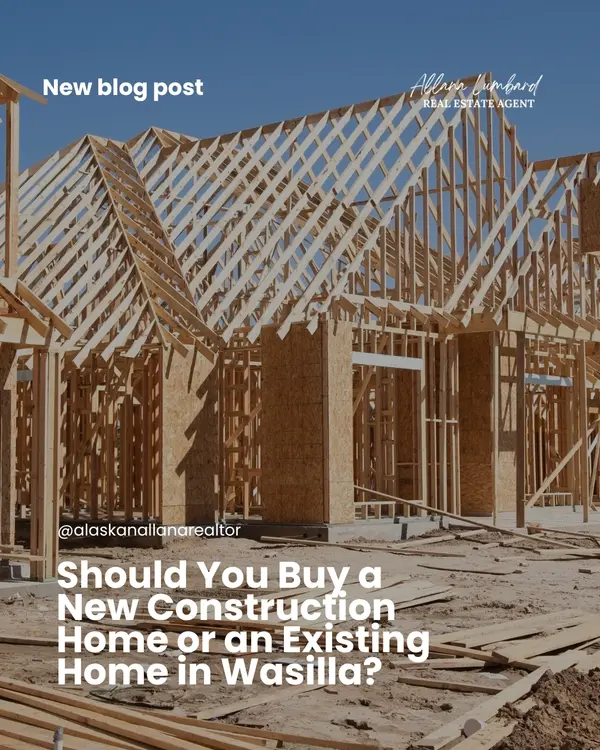
Alaska Home Buying vs. Building: Which Makes More Sense?
First-Time Buyer Guide · Alaska 2026
Building your own Alaska home sounds appealing — full customization, modern systems, no deferred maintenance. Buying an existing home is faster, often cheaper, and far less complex. Here's the honest comparison for first-time buyers in 2026.
The Alaska Reality
Why the Build vs. Buy Decision
Is Different in Alaska
The build vs. buy question has a genuinely different answer in Alaska than in most of the country. The cost gap between building and buying is wider here. The timeline is longer. The contractor supply is thinner. And the "feasibility gap" — the difference between what it costs to build and what the market can support — is a real structural challenge that affects Alaska housing in ways most first-time buyers don't anticipate.
A feasibility gap exists when the cost to build a home exceeds what that home can reasonably sell or rent for. In Alaska, that gap shows up quickly. Construction costs are high. Labor pools are smaller. Materials travel long distances by barge or truck. Fuel prices fluctuate. Weather compresses building seasons. This means that building an entry-level home often costs more than its market value upon completion — which is why for most buyers without a specific compelling reason to build, buying an existing home is more economical in the current market.
That said, building is the right choice for specific situations — and the Mat-Su Valley, where over 60% of Alaska's new construction happens, offers the best conditions in the state to make it work. Developers appreciate that the permitting process is simpler and land prices stay reasonable. Buyers appreciate that they can still find a new home for roughly the same cost as an older Anchorage property. If your needs, location, and timeline align — building can be the right path.
The Real Numbers
What Building vs. Buying
Actually Costs in Alaska in 2026
* Building a standard 1,800–2,200 sq ft home with mid-range finishes in Southcentral Alaska: roughly $450,000–$900,000 before land, well, septic, and site work. National average: $150–$250/sq ft. HomeAdvisor reports it costs more than twice as much to build in Alaska as in Kansas.
That per-square-foot range doesn't include everything. Here's what adds up on top of construction costs for a typical Mat-Su Valley build:
| Additional Cost Item | Wasilla/Mat-Su | Anchorage |
|---|---|---|
| Land (1 acre w/ utilities) | $45,000–$120,000 | $90,000–$200,000+ |
| Well drilling | $10,000–$25,000 | Not needed (municipal water) |
| Septic system | $15,000–$30,000 | Not needed (municipal sewer) |
| Foundation | $35,000–$70,000 | $35,000–$70,000 |
| Driveway, clearing, site work | $10,000–$30,000 | $5,000–$20,000 |
| Material premium vs. Lower 48 | +15–20% on all materials | +15–20% on all materials |
| Labor (30–40% of total build cost) | Higher in Valley (limited trades) | Slightly more available |
For context: a one-acre lot with power and natural gas in the Mat-Su Valley sells for between $80,000 and $100,000. Add that to a $450,000–$600,000 construction cost for a 1,800 sq ft home, plus well, septic, and site work, and a full Mat-Su build can easily run $600,000–$800,000 — more than many comparable existing homes in the same area sell for.
The feasibility gap in practice: It is easy to look at open space around Palmer, Wasilla, or Big Lake and assume housing should be cheaper. Construction costs are high, labor pools are smaller, materials travel long distances by barge or truck, and weather compresses building seasons. By the time a home is finished, the numbers often do not pencil out. If you're building to save money, the math usually doesn't support it in Alaska. If you're building for customization, land specificity, or quality control — those are legitimate reasons.
The Time Factor
How Long Each Path
Actually Takes in Alaska
Timeline is the most dramatic practical difference between buying and building in Alaska. Alaska's compressed outdoor construction season — approximately five months — is the primary constraint. From groundbreaking to certificate of occupancy, most Alaska custom home builds take 12–18 months in Anchorage and the Mat-Su Valley, with Southcentral Alaska's five-month outdoor construction season as the primary constraint. Remote or Southeast Alaska builds can stretch to 18–24 months. Budget your living situation accordingly — construction rarely finishes on the original schedule.
- →Pre-approval: 1–2 weeks
- →Home search: 2–8 weeks depending on market
- →Offer to close: 30–45 days (conventional/FHA)
- →Total: 2–4 months from decision to keys
- →AHFC loans: 35–50 days to close due to PUR-102
- →Cash: 14–21 days to close
- →Land purchase and financing: 1–3 months
- →Plans, permits, and lender approval: 2–4 months
- →Construction: 12–18 months (Southcentral AK)
- →Total: 15–24+ months from decision to keys
- →Weather delays routinely add 1–3 months
- →Remote/SE Alaska: up to 24 months or more
For first-time buyers with an immediate housing need — lease ending, relocation deadline, school-year timing — the 15–24 month build timeline is simply not workable. Building is a choice for buyers with housing security while they wait, not an alternative to a fast purchase.
The Trade-Offs
Buying vs. Building —
Honest Pros and Cons
- →Fast — close in 30–45 days
- →Simpler financing — standard purchase mortgage
- →AHFC First Home programs available immediately
- →Established neighborhoods with mature character
- →No construction risk (cost overruns, delays)
- →What you see is what you get
- →Older housing stock (avg 40+ years in Alaska)
- →Potential deferred maintenance and inspection findings
- →Limited inventory in some price ranges
- →Competitive summer market — multiple offers common
- →No customization — accept the existing layout and finishes
- →Full customization — layout, finishes, systems
- →Zero deferred maintenance — everything is new
- →Modern insulation and energy codes = lower heating bills
- →AHFC $10,000 new build bonus available
- →No competing offers during construction
- →Choose your own land and lot
- →Costs 15–30% more per sq ft than comparable existing
- →Timeline: 15–24+ months start to finish
- →Complex financing: construction loan + permanent mortgage
- →Construction risk: cost overruns, weather delays, contractor issues
- →Well, septic, and site work add $35,000–$80,000 in Mat-Su
- →Limited contractor supply drives up labor costs
How Financing Differs
Construction Loans vs. Purchase
Mortgages — What Changes
The financing process for a custom build is fundamentally more complex than buying an existing home. Instead of a single standard mortgage, you typically need a construction-to-permanent loan — a two-phase product that funds the build as it progresses and then converts to a permanent mortgage at completion.
| Financing Factor | Buying Existing | Building Custom |
|---|---|---|
| Loan type | Standard purchase mortgage | Construction-to-permanent loan (or two separate loans) |
| Down payment | 3.5% (FHA), 0% (VA/USDA), varies conventional | Typically 20–25% required by most construction lenders |
| Rate during build | N/A | Higher rate during construction phase; converts at completion |
| Interest payments | Full monthly payment from close | Interest-only on draws during construction |
| Appraisal basis | Comparable sales of existing homes | "As-completed" appraisal — estimated future value |
| AHFC programs | First Home Limited available immediately | $10,000 new build bonus + AHFC rate programs available |
| Complexity | Standard — well-understood process | High — multiple draws, inspections, and approvals |
| VA loan eligibility | Yes — zero down with full entitlement | Yes for construction — but more complex; not all VA lenders do construction loans |
The AHFC $10,000 new build bonus: AHFC offers a $10,000 bonus for buyers purchasing new construction homes on lots excavated after January 2, 2025. This can be stacked on top of AHFC First Home Limited rate discounts and AHELP down payment assistance — making it one of the most compelling financial reasons to choose new construction if you qualify. Ask your AHFC-approved lender whether the specific property and build you're considering qualifies. See our Alaska new construction guide for the complete program breakdown.
The Decision Framework
When Building Makes Sense —
And When It Doesn't
Building makes the most financial and practical sense when you have a compelling specific reason: a family land parcel, a unique view or waterfront lot that isn't available to buy, specific accessibility needs, or very particular layout or sustainability requirements. If the specific land is the point — not just the new home — building makes sense. Without a specific land reason, buying a comparable newer resale home or a spec-built new construction home in the Mat-Su Valley is almost always more economical.
Construction lenders typically require 20–25% down — and you need to maintain your current housing while the build progresses. If you're currently a homeowner with equity who wants to build your next home before selling, that equity can fund the down payment and bridge the gap. First-time buyers without existing housing equity and without a place to live during a 15-month build are the least suitable candidates for a custom build. The economics and logistics rarely work in your favor at this stage.
Any timeline under 12 months is a buying situation, not a building one. Lease ending, job relocation, school-year deadline, growing family — if you have a defined move-in date, buying is the only realistic path. The pre-construction phase alone (land, plans, permits, financing) takes 2–4 months before a shovel touches dirt. Browse Wasilla listings, Palmer listings, and Anchorage listings to see what's available now.
The best of both worlds for many Alaska first-time buyers: a newly-built spec home in a Mat-Su Valley subdivision. You get modern construction, new systems, and no deferred maintenance — with a standard purchase mortgage (not a construction loan), a faster closing timeline, and potential access to the AHFC $10,000 new build bonus. Over 60% of Alaska's new homes are built in the Mat-Su Valley, with Wasilla having the most active builder market. See our Alaska new construction buyer's guide for what to look for and how builder contracts work.
The honest bottom line: For most Alaska first-time buyers, buying an existing home is the right first move — faster, simpler, cheaper per square foot, and accessible through AHFC programs from day one. Building makes sense for the specific buyer with a specific land reason, housing stability during a long build, and a substantial down payment. If you're not sure which path fits your situation, reach out to Allana for a candid conversation — including what's currently available to buy in your target area and whether any spec new construction fits your needs. Or get a free home evaluation if you're a current homeowner weighing whether to sell and build.
Sources & Data
- Alaska Home HQ — Cost to Build a House in Alaska 2026, March 2026
- Valley Market — Where Alaska Builds: Why the Mat-Su Valley Leads the State in New Homes, November 2025
- Valley Market — Alaska's Feasibility Gap and the Real Housing Shortage, February 2026
- Alaska Home Builder — Cost to Build a House in Wasilla vs. Anchorage: 2026 Price Breakdown, February 2026
- Alaska Home Builder — Building a House in Alaska: Custom Home Costs & Average Construction Pricing
- Land Boss — What an Acre of Alaska Land Is Worth in 2026
- The Mortgage Reports — Buy or Build a House: What's Cheaper? 2026 Cost Comparison
- AHFC — First-Time Homebuyer Loan Programs & New Construction Bonus
This blog is for informational purposes only and does not constitute financial, legal, or real estate advice. Construction costs, loan terms, program eligibility, and market conditions change — always verify with a licensed Alaska real estate professional, AHFC-approved lender, and licensed contractor before making build or buy decisions. Data current as of June 2026.
Recent Posts